Google Ads – Bidding Strategies
Your customers are online. They are searching for products and services that can satisfy their needs. Google Ads are one of the best ways of reaching your potential customers online.
Knowing about Google Adwords bidding strategies is important for anyone looking at advertising on Google.
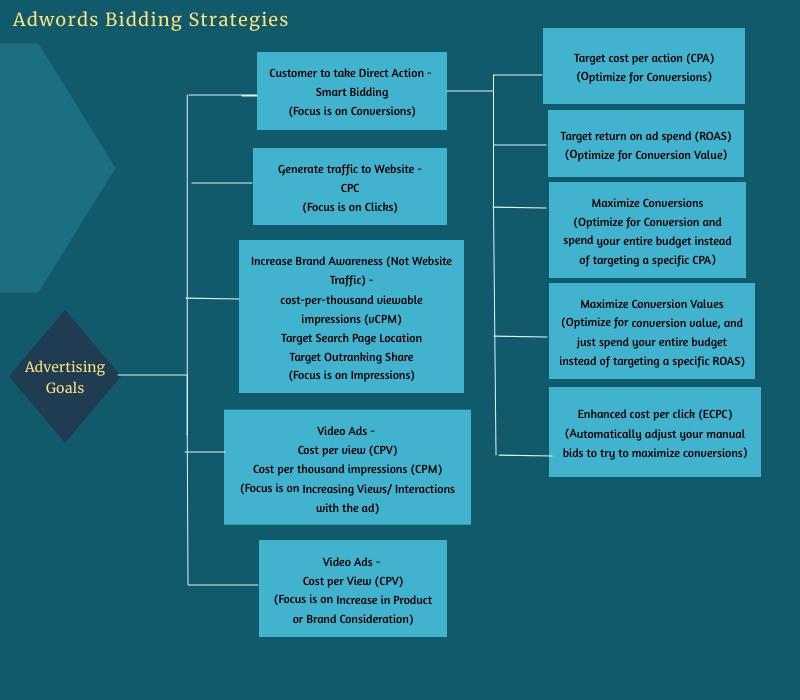
Google adwords bidding strategies are based on the advertising goals. These goals can be:
(a) Focus on Conversions: Use Smart Bidding strategy. Smart Bidding or automated bid strategies use machine learning to optimize for conversions or conversion value in each and every auction—a feature known as “auction-time bidding.”
Smart Bidding strategies can be:
- Target cost per action (CPA) – Cost per Acquisition is the amount of money you can afford to spend on acquiring one customer.
- Target return on ad spend (ROAS) – Target ROAS is the bidding strategy where Google Ads will set your bids to maximize conversion value based on the return you want from your ad spend. This number is percentage based.
- Maximize Conversions- Using the maximum daily budget that you set, Google will automatically run your bidding for you to get you the most conversions for your money.
- Maximize Conversion Value-
- Enhanced cost per click (ECPC) – Google has the right to increase or decrease your bid amount based on the likelihood of driving the sale. Bids will try to be averaged out at your max cost per click settings.
(b) Focus on Clicks:
Advertisers can use two cost-per-click bid strategies:
1. Maximize clicks – is an automated bidding strategy. The advertiser fixes a daily budget and Google Ad system automatically manages the bids. The goal is to bring in the most clicks within the budget.
Maximizing Clicks isn’t a good choice if the advertising goal is to maintain an ad position or CPA.
2. Manual CPC bidding – Lets the advertisers control the cost and volume of clicks on their ads.
(c) Focus on impressions:
Following bid strategies can be used:
1. Target Search Page Location- It is an automated bidding strategy where Google Ads automatically raises or lowers your bids to show your ad on the top of the page or on the first page of Google search results. This bid strategy works with campaigns targeting the Search Network only.
2. Target Outranking Share– Another automated bidding strategy that lets you choose a domain you want to outrank so that your ad is displayed above that domain’s ads, or shows when that domain’s ad does not.
3. Target impression share– (June 2019) Advertisers are no longer able to use the Target Search Page Location or Target Outranking Share bidding strategies. All the campaigns with these strategies will be automatically mograted to the Target impression share bidding strategy.
Target impression share is a Smart Bidding strategy that automatically sets bids with the goal of showing your ad on the absolute top of the page, on the top of the page, or anywhere on the page of Google search results.Advertisers can use can use ‘Absolute top impression share’ or ‘Top impression share’ to aim for the top of the page using Target Impression Share.
4. CPM– Advertisers pay based on the number of impressions (times the ad was shown) that they receive on YouTube or Google Display Network.
5. vCPM– This manual bidding strategy can be used to increase awareness but not necessarily generate clicks or traffic. Advertisers can set the highest amount they want to pay for each 1000 viewable ad impressions on Google Display Network.
(d) Focus on views or intractions (for video ads only): Advertisers can use CPV bidding strategy for video ads. Advertisers enter the highest price they want to pay for a view while setting up the TrueView video campaign. Thus, they pay for video views and other video interactions like clicks on the CTA overlay, cards or company banners.
Always remember: Remember your Goals.
Choosing the right bidding strategy will ultimately depend on your advertising goals:
Do you want to increase brand awareness? or website traffic? or are you targeting the number of impressions?
Once the goal is clear, it is easier to pick a bidding strategy for Google Ads.
 Digital Marketing